Showing posts with label A Short Guide. Show all posts

Tuesday, 16 July 2013

Top 10 Best Martial Arts Films - Reviews and Videos

Bruce lee

10. Kagemusha

A samurai film with an emotional plot. A nobody is hired as a double for one of the most powerful samurai warlords in Japan, Takeda Shingen. However, when Takeda dies, how long will it take before his enemies and allies figure out the double's true identity?

9. Red Cliff

This is a must-see martial arts film for anyone with an interest in China's Three Kingdom's period or fans of the Dynasty Warriors series. The armies of Xu and Wu desperately try to hold back Cao Cao's imperial army and navy. Battles on epic scales and engrossing characters.

8. Kill Bill: Vol. 2

The sequel to Kill Bill: Vol. 1, this is a fine example of how well the genre of martial arts films mixes with revenge-based scripts. But does the sequel ever live up to the standards of its predecessor? In this case, probably not. But here's a video of how to stop a heart with one hand!

7. Kill Bill: Vol. 1

This film beats its sequel by quite a margin. One of the modern martial arts film greats, Uma Thurman is more than just eye-candy, wielding a katana like a pro. Here's the famous scene where she takes down 88 bad guys in a fight.

6. Ip Man 2

Another sequel which very nearly holds its own with the original Ip Man. This martial arts epic only missed out on being in the top 3 due to the number of near-perfect movies clamouring for the top spot.

5. House of Flying Daggers

The House of Flying Daggers film is one of the best choreographed movies we've seen. Stunning scenery and breathtaking fight scenes ensure that it has earned this spot at Number 5 on the Top 10 list. To give you an idea of what we're talking about, here's our pic of best clip.

4. Hero

Number 4, for an awe inspiring combination of fantastic scenery and dynamic fights, all woven into an incredible plot, check out Hero. Here is the final scene, which was just too good to leave out!

3. Crouching Tiger, Hidden Dragon

Another oldie, Crouching Tiger, Hidden Dragon is a must-see for martial arts films enthusiasts. Memorable scenes involving running up walls (in a more-believable-than-The-Matrix) kind of way and through treetops combined with a riveting plot secure this old-time favourite a spot at Number 3. Watch the video below for some really fast-paced action showing what a girl can really do with a sword (couldn't keep up eh, Kill Bill?).

2. Ip Man

Number 2 and the first Ip Man film, the story still gets me. A tale of China under Japanese occupation and one man's fight against oppression. Ip Man moves hands and feet faster than the human eye can follow in this hit epic martial arts film. Otherwise, I'll let the following video speak for itself.

1. Fist of Fury

The best out of all martial arts films. Bruce Lee plays the part of a young man looking to take revenge on his sensei's murderers in this 1970s film. The best scene in the film is the final segment when Bruce Lee forces his way through his enemy's compound with a storm of kicks, punches and blocks.

What's your Top 10? Leave a comment letting us know your opinions :)

Joe Malpas, also on WordPress

Monday, 15 July 2013

Best App for iPhone

Link

Our Top App Purchase for iPhone

Our favourite app for the iPhone is Instant Heart Rate by Azumio. This heart rate monitor can be downloaded from the app store on the iPhone or iTunes.

What is the iPhone Instant Heart Rate Monitor?

The Instant Heart Rate app allows users to check their heart rate on their mobile phone. You can see your pulse on the screen, track your heart rate over time and monitor your health. If you play sports or exercise regularly, this iPhone app is great for allowing you to check how fast your heart is beating before, during and after a workout. For those more interested in their long-term health, you can use the app to keep track of changes to your resting heart rate day-to-day, week-to-week or on a longer-term basis.

Link
Features of the iPhone Instant Heart Rate Monitor App

The app is easy to use, all you have to do is place the tip of your finger over your iPhone camera and wait a few seconds while your heart rate is recorded. You can export your heart rate data and share it on Twitter or Facebook. There are also hashtags which allow you to record the situation of each heart rate record, each hashtag is listed below:
-Post-workout.
-Tired.
-Resting.
-Just woke up.
-Before bed.
-Exercising.
-New tag. You can use this option to create your own custom tags.

Joe Malpas


Wednesday, 10 July 2013

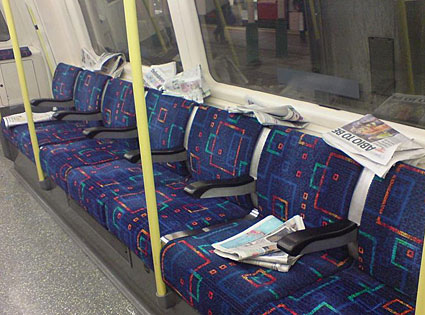
On the London Underground - A What Not To Do!

Yet another morning on the tube, and I find myself faced with people's utter disregard for other journeyers. Why pray tell do some of us feel the need to litter seats with rubbish, take up excess amounts of space or generally take the time to piss people off. Maybe I feel too strongly about this, but it takes a second to not do half the little things. Some of this applies to buses, but all of it is common sense. Here's my little list of things that people do, and how to not do them!

The two big ones:

Sitting on the tube:
So often on the tube do people take up more than one seat. I'm not complaining about people on the heavy side, while I have my views on being overweight this isn't the issue. I'm talking about people of average weight, who manage to take up one to two seats on the tube. It's not as if the seats aren't well defined, there's a horribly uncomfortable red division between every place.
And yet, people put their bags in a seat and refuse to move it until either every other seat on the tube is taken, or you go up and ask. People (usually men) sometimes sit with their legs so far apart that they encroach onto the next seat. Many a time have I found a leg pressed into mine regardless of how far I shift away. I understand that it may be uncomfortable to keep your legs together guys, but its uncomfortable to have your legs on mine...


Where to put rubbish?
I know that there are no bins in the stations, or on the tube. There are however bins on every street, and in buildings across London. Leaving that scrunched up plastic bag with the remnants of lunch, that greasy, smelly paper fast food wrapper, the unloved newspaper or whatever other delights you may have is inconvenient, and unpleasant. Especially when you left on a seat for an unsuspecting pair of bloggers on their way into town. Litterers, you are much more likely to find a bin, than the rubbish is likely to magically transport itself to the land of litter!

/


The little ones:

When to move seats?
Seats on the tube at rush hour are a precious commodity. Nobody wants to be part of the sweaty standing mess on the London underground.  So once you notice someone that deserves to sit down more than you, it makes sense to get up right? Oh no, many a time I have seen people stare into their laps, at their phones etc. All in an effort to not make eye contact, no eye contact? No reason to move! As a sufferer of chronic back pain when standing for extended periods of time, I rarely want to move. That doesn't stop me from getting up when I can though... Unless you intend to be on the tube for more than half an hour, let's move for those who need to sit more than us?
During the off peak hours of the tube, I've noticed that there is a strong aversion to sitting next to someone when there's an option to sit with a nice empty seat on either side. I do it myself. Nobody really wants to sit next to a stranger. However, every once in a while a couple of people, friends, parent and child, or an actual couple board, and start looking for seats. They look around hopefully and then resign themselves to a silent journey across from each other, or a few seats apart. There's no need to go out of one's way to do this, but when it involves shifting over by one seat, or across the isle, would it be so hard to do so? Or at least to offer? Its little to no effort on our parts, but might make a few people happy, and where's the harm in that?

Boarding etiquette:
This is a tiny thing, there are signs, and announcements about this very topic. Wait for people to get off, and then get on. Easy enough, but there's always people so impatient that they absolutely have to get on before everyone else can get off and free up the space. The tube won't leave that quickly, just wait a minute!

Lost in the station?
This is applicable to any crowded location in the world, but I notice it most on the tube. I'm rushing to class, my train is at the platform and I have mere seconds to get on and... someone stops. Right in front of me,  or maybe they slow down and dither about. Just long enough to make me miss my train, or maybe I'll get lucky? I'll barrel through the doors just as they're closing. While it's probably not the end of the world, its damn frustrating.

That's it for now. At 10:40pm I'd rather be watching Dexter instead of thinking about the tube!

Alina

Other articles you may find interesting: War and Peace - Book Review, A Guide to Freelance Writing

Tuesday, 9 July 2013

Freelance Writing Online

Becoming a freelance writer

Why become a freelance writer?

Freelance writing sounds like a fun career path to take. It can be rewarding in both personal and financial terms, and the greatest perk is that you can do it from anywhere you like. An on-line freelance writer can work from their local cafe or home, and that freedom of choice concerning a freelancer's workplace is one of the most enticing aspects of freelance writing.

What skill set do you need?

- A good command of the English language is an absolute must, there's little point applying for a job like this when you aren't able to communicate to the standard required.
- Quality control, as a freelance writer you have to make sure that you are meeting the standard that your client will expect. Shoddy grammar, incorrect punctuation and misuse of vocabulary make for unhappy clients. And an unhappy client makes for an unemployed freelancer.
- Proof reading! Sounds like it should be part of quality control right? Proof reading is so important that I feel it needs it's own point. It's easier than you would imagine to miss the little mistakes in your writing. It becomes second nature after a time; so don't worry; but at the beginning it doesn't hurt to get someone to check it over for you (Alina is checking my spelling as I type).
- Creativity, time management and formatting are all minor points, but important nonetheless. Make sure you can use word (or whichever software you prefer), that you notice when you've missed lunch in your typing haze, and take a moment to stop and do something relaxing for a while. You're a freelancer for a reason, right?

Where do you begin?

The first phase of a freelancer's career (as with many other careers) is the most challenging. Many do not know where to look for jobs or how one even becomes an on-line freelance writer. The best place to start searching for freelance work is on noticeboards and dedicated websites. Sites such as Elance and Problogger are examples of the above. These two examples (and others like them) display lists of jobs for freelance writers. These job opportunities are posted by companies or individuals looking to hire fresh writing talent, that means you! So getting started doesn't have to be such a daunting experience.

How I became a freelancer...

My personal experience was different, but equally challenging. I actually found a job almost as soon as I started. However, not every writing job is a good one. This particular opportunity had three major flaws. Firstly, the pay was too low. Secondly, the subject area which I was being asked to cover was not an area of interest for me. Thirdly, the client was slow to respond to my correspondence.

Why is low pay a problem?

The answer to this question seems obvious, but why isn't low-paid freelancing like any other minimum wage job? The answer is that in freelance writing you are often paid by word count. In this case I was paid per thousand words. A low rate of pay per thousand words meant that I was forced to write as many thousands of words as I could in a limited amount of time. Researching and writing in such a way can wear you out and sap the fun out of an enjoyable career.

Why only write about things that interest you?

The answer to this question is simple. You will always be better at things which you enjoy. Writing thousands of words on a boring topic is a draining activity, as I can attest from personal experience. If you want to write great articles and get positive feedback from clients, pick the projects which best suit your personality and interests. Don't be afraid to be picky.

The importance of communication...

Communication is an essential aspect of any successful project. Your client will know what they want and have their own ideas to contribute. They will also appreciate your feedback and creative input. So try to maintain contact with the client throughout the creative process, exchanging ideas, feedback and making sure that you are giving them the content they want (even if they didn't know they wanted it when the project began).

What comes next?

The next step is sending CVs, proposals and examples of previous work to potential clients. Don't just apply for one position at a time. Go after every position which looks like a good fit. If you only get one then you can count it as a success. If you get more than one project then congratulations (seriously, well done you!). But remember not to take on too much work at one time or you might end up wearing yourself out (not to mention keeping the rest of us out of work!).

Other articles you might like: 'War and Peace' - Book Review, Welcome

Joe Malpas (contributions by Alina, the over-the-shoulder editor!)